Legal NGO FLAC launches Annual Report; Reports a 10-year high in legal queries answered by its phoneline and calls for urgent action in response to the deepening “legal aid crisis”
13 July 2026
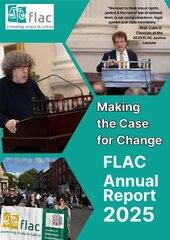
Minister for Justice Jim O’Callaghan TD launched FLAC’s 2025 Annual Report, titled “Making the Case for Change” on Monday, 13 July 2026. FLAC (Free Legal Advice Centres) promotes access to justice through its Telephone Information and Referral Line, Free Legal Advice Clinics, public interest casework, targeted legal services (for the Roma and Traveller communities), and policy and law reform work. Headline figures from 2025:
In July 2025, the reports to emerge from the first ever comprehensive review of Ireland’s civil legal aid system were published. Eilis Barry (FLAC Chief Executive) submitted a Minority Report. FLAC is campaigning for the implementation of its clear, practical and cost-effective recommendations to resolve the legal aid crisis. Eilis Barry, FLAC’s Chief Executive, comments: “FLAC’s 2025 Annual Report highlights the extent of unmet legal need that our hugely oversubscribed Telephone Information & Referral Line, Traveller Legal Service and Roma Legal Clinic encounter on a daily basis. FLAC has nowhere to refer people with problems in areas like landlord/tenant, employment and discrimination law because the Legal Aid Board cannot provide legal representation in cases before tribunals like the WRC or RTB. It also has no function to provide legal information. It was this unmet need and the inadequacies of the Civil Legal Aid scheme that were the catalyst for FLAC’s campaign for a comprehensive review of our civil legal aid system. It is now almost one year since the reports to emerge from that review were published. Since then, the Legal Aid Board itself has acknowledged that Ireland’s system of civil legal aid is not just in crisis but may collapse and, only recently, the Oireachtas Justice Committee has called for urgent action from the Minister to address the crisis. What is needed now is action. Comprehensive, meaningful reform is doable, practical and cost effective. Establishing general and targeted information services, a network of targeted law centres and community law centres in the areas of highest deprivation are comparatively cheap measures and would transform access to justice for the most disadvantaged communities. We fervently hope that the Minister will use this once in a generation opportunity to establish a fit for purpose system of public legal assistance and urgently outline a civil legal aid reform plan. In addition to our concerns about the delay in implementing urgently-needed civil legal aid reform, we are also concerned about a number of regressive measures. The Equality Bill which would have greatly improved our equality legislation has effectively stalled with no progress since it was considered by the Oireachtas Equality Committee last year. The Housing Bill which is currently being rushed through the legislative process is likely to lead to a rise in homelessness and destitution amongst minority ethnic and migrant communities. We have also made strenuous objections and submissions in relation to the proposed reforms of judicial review in the Civil Reform Bill, which could greatly reduce and block access to judicial review. Judicial review is often the only available remedy for the disadvantaged groups and individuals that FLAC represents, who are trying to access basic public services like emergency accommodation, housing and social welfare. It is vital that the recently published recommendations of the Oireachtas Justice Committee in relation to the Civil Reform Bill are implemented and that the Minister and his department engage, as promised, with people and groups who will be adversely affected by it.” Other policy and law reform highlights from 2025 include:
Dr Fiona Donson, FLAC Chairperson, comments: “Throughout 2025, FLAC was very fortunate to be able to draw on the deep commitment to access to justice within the legal profession, civil society, law schools and student societies across the island of Ireland. FLAC’s work would not be possible without those who volunteer to support the organisation, including the volunteers and law firms working on the phoneline and in clinics, the barristers who assist with casework, and the members of the PILA alliance. We are also immensely grateful to all of our funders – from Government Departments and statutory bodies to the Law Society, the Bar of Ireland, and philanthropic organisations such as the Community Foundation of Ireland, as well as our wide array of sustaining and supporting partners, individual law firms, practitioners and private individuals - for providing the crucial financial resources that allows FLAC to undertake its work.” ENDS/
Notes to Editors:
FLAC (Free Legal Advice Centres) is an independent legal, equality and human rights non-governmental organisation which works in a number of different ways to promote access to justice:
Detailed Telephone Information & Referral Line Figures FLAC’s Telephone Information & Referral Line team responded to 14,103 queries in 2025. In addition to this, the team on FLAC’s Telephone Information and Referral Line also made 2,360 call backs to service users to provide them with further information or set up an appointment in a FLAC clinic. In 2025, 647 calls to FLAC’s Telephone Information & Referral Line were from lay litigants or ‘litigants in person’, which represents 5% of all calls. FLAC regularly receives calls from people who are endeavouring to represent themselves in complex court cases, navigating complex rules and procedures, and desperately in need of legal assistance which FLAC does not have the capacity to provide. Family law remains the area in which the Telephone Information & Referral Line receives the most queries (3,524 queries – which is 25% of all queries):
2025 saw the highest number of employment law queries ever recorded on the Telephone Information & Referral Line, accounting for almost one quarter (23.5% - 3,317 queries) of all calls in 2025 and up 42% compared with the previous year.
|