FLAC welcomes Oireachtas Committee’s call for “urgent reform of the Civil Legal Aid system”; Minister must take action amidst “warnings that the system could collapse”
2 July 2026
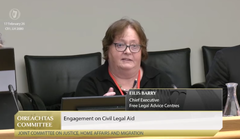
FLAC has welcomed the publication of the Oireachtas Justice Committee’s Report on Civil Legal Aid which highlights a “a serious and growing [civil legal aid] crisis”. The report highlights that civil legal aid is a “vital public service” and calls for “urgency to address the crisis”.
It is nearly a year since the Majority and Minority reports to emerge from the first ever comprehensive review of civil legal aid in Ireland were published. The Justice Committee has called for "the recommendations made in both the Majority and Minority report of the Civil Legal Aid review [to be] considered as a matter of urgency".
The Justice Committee have made a range of recommendations which align with FLAC’s calls for reform of the civil legal aid system. FLAC particularly welcomes the recommendations for:
- “‘[I]mmediate and adequate funding [being] made available to the Legal Aid Board”. At present, resourcing issues give rise to significant delays in access to legal aid. The waiting time for a first appointment with a Legal Aid Board solicitor stands at 48 weeks in Ballymun and Navan, 55 weeks in Ennis and 60 weeks in Sligo.
- Reform of the very restrictive legal aid means and merits tests. The means test for civil legal aid has not been updated in almost 20 years and sets an €18,000 disposable income limit.
- Removing the ban on legal aid being provided to people who need representation in cases heard by bodies like the WRC, RTB and in social welfare appeals. The ban applies no matter how complex or urgent the case is.
- “[Providing] access to legal information, advice and advocacy as early as possible” and “greater consideration [as] to how the Legal Aid Board and Citizens Information Board could provide …general and targeted legal information and …enabling the Citizens Information Board to provide advocacy in non-complex cases”
- The “rates of pay available to Legal Aid Board solicitors [being] immediately amended to bring parity with other solicitors employed in the Civil Service” and “a review of the private practitioner scheme model in order to assess how to make the model financially viable for professionals”
FLAC Chief Executive, Eilis Barry, commented today:
“It is extremely hard to attract the attention to the issue of civil legal aid. It is even harder to achieve meaningful change in this area. We very much welcome the Committee's recognition that civil legal aid is a vital public service and that there is a serious and growing crisis that needs to be addressed as a matter of urgency.
What is needed now is action to ensure that legal aid services are provided to people who desperately need them and who currently have no access to the assistance which they require to access justice. The scheme has been reviewed in detail and further reviews (which the Committee recommends in certain areas) may only lead to drift and inertia. The Committee’s call for ‘phased reform’ may give rise to similar issues.
There is presently no legal aid for tenants challenging unlawful evictions in the RTB, workers and victims of discrimination, harassment or sexual harassment taking difficult cases in the WRC, parents taking complex social welfare appeals about access to disability supports for their children, or people with disabilities seeking reasonable accommodations in schools and workplaces. These issues require an urgent, rather than phased, response.
It is not unreasonable to expect the Legal Aid Board to be able to advise people on a range of issues rather than being primarily focused on family law. We also do not see the rationale for maintaining the financial contribution requirement for access to legal aid (which is out of step with other essential public services).
The experience of FLAC’s Legal Information Telephone Line demonstrates that there is a significant need for properly-resourced legal information and advice services which, at present, the Legal Aid Board does not provide. People urgently need access to information that can prevent their problems from escalating into costly catastrophes. It is disappointing that the Committee’s recommendations do not address the need for community and targeted legal services which bring legal assistance to where people are.
Expanding the services provided by the Legal Aid Board would be very cost effective and reduce overall legal need. FLAC estimates that a properly-resourced national legal information telephone line would only cost about €2.5 million annually. Targeted and community services would only cost approximately €1.5 million per law centre each year.
It is deeply disappointing that the Minister for Justice has yet to issue a full response to their findings or set out an implementation plan or roadmap for reform. The Minister must address the issues presented in the reports, the Justice Committee’s report, and implement a plan for reform. We hope that the Committee will continue to champion the area of civil legal aid and will seek updates and a meeting with the Minister and his officials about reform in this area.”
ENDS.
- The Committee’s report may be accessed here.
- FLAC’s submission and statement to the Justice Committee regarding Civil Legal Aid may be accessed here.
- FLAC, along with a group of 45 NGOs, academics and practitioners, successfully campaigned for the comprehensive review of the system of civil legal aid.
- Eilis Barry (FLAC Chief Executive) was the FLAC nominee on the Review Group. She submitted a minority report to the Minister which was joined and supported by Review Group member Professor Thomas O’Malley SC.
- The Civil Legal Aid Majority Report may be accessed here.
- The Civil Legal Aid Minority Report may be accessed here. FLAC’s Briefing Note about Minority Report is available here.
- The most recent civil legal aid waiting times may be access here.
About FLAC:
FLAC (Free Legal Advice Centres) is an independent legal, human rights and equality organisation, which works in a number of different ways to promote equal access to justice:
- In 2024, our Telephone Information and Referral Line responded to 11,435 queries. FLAC also provides Phone Legal Advice Clinics.
- Our independent law centre provides targeted legal services for the Traveller and Roma communities and also undertakes public interest litigation (i.e. cases which may have an impact beyond the individual).
- FLAC also operates PILA which facilitates NGOs to obtain legal assistance from private lawyers via its pro bono referral scheme.
- FLAC makes policy recommendations in relation to areas of law that most impact on people living in poverty and disadvantage, including equality and anti-discrimination law, social welfare law, housing law, human rights law, and access to justice.