Groups North and South of Ireland Unite to Warn UK and Ireland Against Weakening Human Rights
12 May 2026
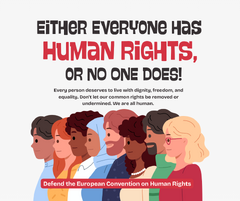
Groups North and South of Ireland Unite to Warn UK and Ireland Against Weakening Human Rights: Joint letter sent to UK Prime Minister and Irish Taoiseach ahead of Council of Europe meeting
Civil society organisations, academics and human rights activists from Northern Ireland and Ireland have come together to write jointly to the UK Prime Minister and the Taoiseach, urging both Governments to publicly reaffirm their commitment to the European Convention on Human Rights (ECHR) and to resist any moves that would weaken its protections.
The joint letter, signed by over 90 civil society groups, academics and activists based in both Northern Ireland and the Republic of Ireland, has been sent ahead of a Council of Europe meeting taking place later this week in Chişinău, Moldova on 14–15 May, where states will consider a proposed Political Declaration relating to migration and human rights.
The signatories warn that the proposals currently under discussion risk undermining the universality of human rights protections and weakening the authority and independence of the European Court of Human Rights.
In Northern Ireland, the ECHR has particular constitutional significance as a core part of the Belfast / Good Friday Agreement. Any dilution of Convention protections, the letter argues, would therefore carry serious risks for constitutional stability and public confidence.
For the Republic of Ireland, the letter highlights Ireland’s long‑standing role as a defender of the Convention system and stresses that Ireland’s responsibilities as a co‑guarantor of peace on the island are inseparable from the strength and integrity of the ECHR framework.
The letter was organised by FLAC (Free Legal Advice Centres), based in the Republic of Ireland and the Human Rights Consortium based in Northern Ireland.
Kevin Hanratty, Director of the Human Rights Consortium in Northern Ireland, said “In Northern Ireland, the European Convention on Human Rights is not optional or abstract, it is woven into our constitutional settlement and our peace agreement. Any attempt to weaken, reinterpret or selectively disapply Convention rights risks undermining the foundations of rights protection that support stability and good governance here. Protecting the universality of human rights protections is essential for everyone on this island.”
Eilis Barry, Chief Executive of FLAC said “The European Convention on Human Rights is a practical, living framework that protects people in their everyday interactions with the state – in healthcare, housing, education, policing and the courts. Once we start treating human rights as conditional or negotiable for certain groups, everyone’s rights become less secure. That is why it is so important that Ireland speaks clearly and decisively in defence of the Convention system.”
The letter calls on both Governments to reject any political declaration that would narrow or reinterpret Convention rights or rights‑holders, and to instead take active steps to strengthen the Convention system, including by meaningfully engaging with civil society and national human rights institutions.
ENDS
Notes:
The full text of the letter can be found here.
What is the European Convention on Human Rights (ECHR)?
The ECHR is an international human rights treaty developed by the Council of Europe after the Second World War. It sets minimum standards for the protection of fundamental rights such as the right to life, freedom from torture, fair trial rights, freedom of expression and respect for private and family life. The European Court of Human Rights oversees compliance with the Convention.
Why is the ECHR particularly important in Northern Ireland?
The ECHR is a cornerstone of the Belfast / Good Friday Agreement and is incorporated into domestic law through the Human Rights Act 1998. It provides a shared baseline of rights protections and has played a significant role in supporting peace, accountability and confidence in democratic institutions.
What is the Chişinău process?
The Chişinău process refers to a Council of Europe initiative culminating in a meeting of the Committee of Ministers in Chişinău, Moldova on 14–15 May 2026, when states will consider a proposed Political Declaration on migration and the European Convention on Human Rights.
What are civil society groups concerned about?
Civil society organisations are concerned that elements of the proposed declaration could signal a political willingness to limit or reinterpret human rights obligations under the ECHR. They warn that introducing exceptions or differentiated standards for particular groups undermines the universality of human rights protections and weakens safeguards for everyone over time.
Risks to Articles 3 and 8
Article 3 (ban on torture and inhuman or degrading treatment) is an absolute right.
It allows no exceptions, no balancing and no dilution.
Civil society groups warn that political language suggesting reduced scrutiny in areas such as detention or removal risks weakening one of the strongest protections in human rights law.
Article 8 (right to private and family life) already gives states wide flexibility.
Campaigners say further attempts to “rebalance” rights and state control could make it easier to break up families and interfere with private life, especially in migration cases.
Groups warn that signalling weaker protection for any group sets a precedent. Once universality is undermined, everyone’s rights are less secure.
Signatories to the Letter
Oragnisations - Northern Ireland
Human Rights Consortium
Social Change Initiative (SCI)
Horn of Africa People's Aid Northern Ireland (HAPANI)
Disability Action
Children's Law Centre
Women's Platform
Migrant Centre NI
Irish Congress of Trade Unions
Participation and the Practice of Rights
Friends of the Earth Northern Ireland
Rural Community Network
Women's Resource & Development Agency
NIRWN (NI Rural Women's Network)
North West Migrants Forum
Northern Ireland Youth Forum
The Rainbow Project
Unite the Union (Ireland)
HERe NI
South Tyrone Empowerment Programme (STEP)
Law Centre NI
North West Forum of People with Disabilities (NWFPD)
United Against Racism Belfast
NUS-USI
Organisations - Republic of Ireland
FLAC (Free Legal Advice Centres)
Irish Council for Civil Liberties
Immigrant Council of Ireland
Irish Refugee Council
Irish Network Against Racism (INAR)
Inclusion Ireland
Pavee Point Traveller and Roma Centre
Community Law & Mediation
Mercy Law Resource Centre
National Women's Council of Ireland
GLAN | Global Legal Action Network
Irish Penal Reform Trust
Donegal Travellers Project
Africa Solidarity Centre Ireland (ASCI)
Spirasi (National Centre for Survivors of Torture in Ireland)
AKIDWA - Network of Migrant Women
New Horizon Refugee Support
Donegal Intercultural Platform
Dublin City Community Co-operative
Galway City Partnership
Waterways Migrant Support Group
Academics & Individuals - Northern Ireland
Prf Colin Murray - Lecturer in Law, University of Newcastle
Dr Gillian Kane - Lecturer in Law, Ulster University School of Law
Dr Anne Smith - Senior Lecturer, Ulster University
Juliana Poveda Clavijo - PhD Researcher, Ulster University
Dr Claire Lougarre - Lecturer in Law, Ulster University
Hannah Newburn - Solicitor, Children's Law Centre
Laura Hyde - Lecturer in Law, Ulster University
Michael Oghenetega Abu - Doctoral Researcher
Prf Brandon Hamber - John Hume & Thomas P. O'Neill Chair in Peace, Ulster University
Dr Sarah Craig - Lecturer, School of Law Ulster University
Dr Conall Mallory - Senior Lecturer in Law, Queen's University Belfast
Dr Marisa McVey - Lecturer in Law, Queen's University Belfast
Prf Fionnuala Ni Aolain - Professor of Law, Queen's University of Belfast
Ciara j McHugh - Academic, educator, Queen's University of Belfast
Professor Louise Mallinder - Professor of Law, Queen's University of Belfast
Academics & Individuals - Republic of Ireland
Dr Andrew Forde - Assistant professor in International Law, Dublin City University
Michael Farrell - Former Member of ECRI, European Commission against Racism and Intolerance
Emily Williams - Policing and Justice Policy Officer, Irish Council for Civil Liberties
Prf Colm O'Cinneide - Professor of Constitutional and Human Rights Law, UCL
Damien Peelo - Community Worker
Prf Donncha O’Connell - School of Law, University of Galway
Dr Edel Hughes - Lecturer in Law, Irish Centre for Human Rights, School of Law, University of Galway
Prf Ciara Smyth - School of Law, University of Galway
Prf Ray Murphy - School of Law, University of Galway
Cillian Bracken - Barrister
Janos Fiala-Butora - Senior Lecturer, University of Galway, School of Law
Colin Smith SC - Barrister
Garry O'Halloran BL - Barrister
Aoife McMahon - Barrister
Noeline Blackwell - Human rights lawyer and campaigner
Calum MacLaren - Researcher
Dr Maeve O’Rourke - Senior Lecturer in Human Rights Law, Irish Centre for Human Rights, University of Galway
Gerry Liston - Solicitor
Clare Crowley Collier - Volunteer with a support group for International Protection Applicants
Prf Roja Fazaeli - Professor of Law and Islamic Studies, University of Galway
Noeleen Healy - Barrister
Úna Chambers - Activist on behalf of the Afghan community
Alan Greene - Reader in Constitutional Law and Human Rights, Birmingham Law School
Jane Fraher - Chairperson, The Three Sisters Women's Shed
Sarah Clancy - Community Worker and Poet
Aoife Butler - Social care worker
Patricia Jimenez - Integration support worker
Prf Shane Darcy - Professor, Irish Centre for Human Rights, School of Law, University of Galway
Ololade Olawale-Adeniyi - Integration Officer
Frank O'Boyle - Manager, Irish Refugee Council
Nick Henderson - Chief Executive, Irish Refugee Council
Mary Henderson - Solicitor, Immigrant Council of Ireland
Prf Tarlach McGonagle - Law Professor
Zahraa Fakih - Psychosocial Officer, Spirasi
Jaime Hutton - Youth Worker