Urgent reform needed to avoid the collapse of Ireland’s system of Civil Legal Aid during 2026, FLAC tells Oireachtas Justice Committee
17 February 2026
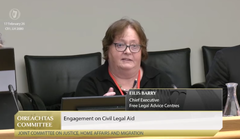
FLAC (Free Legal Advice Centres) has appeared before the Joint Oireachtas Committee on Justice, Home Affairs & Migration this afternoon (17 February) as part of the Committee’s examination of Civil Legal Aid in Ireland.
In her statement to the Justice Committee, FLAC Chief Executive Eilis Barry emphasised that Ireland’s “system of civil legal aid delivered by the Legal Aid Board is in crisis. It is failing to meet huge amounts of legal need, particularly amongst groups who experience disadvantage and discrimination. Ireland’s system of civil legal aid may go from crisis to collapse altogether during 2026 (because of the huge increase in the LAB’s workload arising from the implementation of the EU Migration Pact) if urgent action is not taken.”
She highlighted that:
- The Legal Aid Board is chronically underfunded and under-resourced. In 2025, it had a budget of €64.122m. To put this in context, the horse and grey hound industries received €100 million in this and last year’s budgets. Private education is also subsidised in the amount of approximately €100 million each year. The State has spent €58 million in respect of the Ryder Cup which is €1 million less than the Legal Aid Board’s 2024 Budget.
- Under-resourcing leads to huge delays for a first consultation with a solicitor, with waiting times of up to 64 weeks in parts of the country.
- The outdated legal aid means test has not been updated since 2006 and means that people with a disposable income of more than €18,000 cannot access to civil legal aid.
- Exemptions to the scheme of civil legal aid mean that people with cases before tribunals in important areas such as social welfare, employment, discrimination and landlord/tenant law have no access to legal representation from the Legal Aid Board. The scheme of civil legal aid simply does not cover those areas regardless of the complexity of the cases or the vulnerability of the applicants.
- Resolving the civil legal aid crisis requires proper resourcing of the scheme of civil legal aid and reforms to the scheme including the provision of early and targeted legal services (such as information, community education, advice and advocacy services). The recent civil legal aid minority report sets out “doable, practical and cost effective” recommendations for a “legal aid system which prevents and resolves the legal problems individuals and communities experience as early (and efficiently) as possible.”
Eilis Barry’s statement to the Justice Committee concludes:
“We need to reject the entrenched cliché that legal aid is just ‘more money for lawyers’. It is vital to stress that there is research into whole different range of legal aid systems which shows that for every euro spent on access to justice there will be savings and benefits for individuals, communities, the courts and society. This has been firmly established by OECD and World Bank research. Access to justice is, and has to be regarded as, an investment, and a vital public service akin to healthcare and education.
Given the imminent risk of collapse of legal aid services, it is alarming that the Minister and his Department have not yet provided any timeline for when they will respond fully to the Civil Legal Aid Review or introduce reforms in this area. As the Chief Justice pointed out at the recent civil legal aid conference, the pace of change is ‘frustratingly slow.’”
ENDS
- Eilis Barry’s full statement to the Joint Committee may be accessed here.
- FLAC’s full written submission to the Committee may be accessed here.
About FLAC:
FLAC (Free Legal Advice Centres) is an independent legal, human rights and equality organisation, which works in a number of different ways to promote equal access to justice:
- In 2024, our Telephone Information and Referral Line responded to 11,435 queries. FLAC also provides Phone Legal Advice Clinics.
- Our independent law centre provides targeted legal services for the Traveller and Roma communities and also undertakes public interest litigation (i.e. cases which may have an impact beyond the individual).
- FLAC also operates PILA which facilitates NGOs to obtain legal assistance from private lawyers via its pro bono referral scheme.
- FLAC makes policy recommendations in relation to areas of law that most impact on people living in poverty and disadvantage, including equality and anti-discrimination law, social welfare law, housing law, human rights law, and access to justice.